Skip to content

UHMW-PE & HDPE Machining Services

UHMW-PE & HDPE MACHINING SERVICES

UHMW-PE & HDPE Machining Services

UHMW is easy to cut and hard to hold size on, and those are two different things that get confused constantly. The material has a thermal expansion roughly eighteen times that of carbon steel a one-degree Fahrenheit swing moves a ten-inch UHMW part by 0.0011", more than twice a ±0.0005" tolerance budget. It also deflects under tool pressure and springs back, so a 0.500" bore can measure 0.495" once the fixture is released. 

So we quote ±0.005", and we explain why rather than quoting a number we cannot deliver. Steelcrest machines and fabricates UHMW-PE and HDPE wear strips, guides, conveyance components and food-contact parts in Wauseon, Ohio, including FDA-compliant grades. 

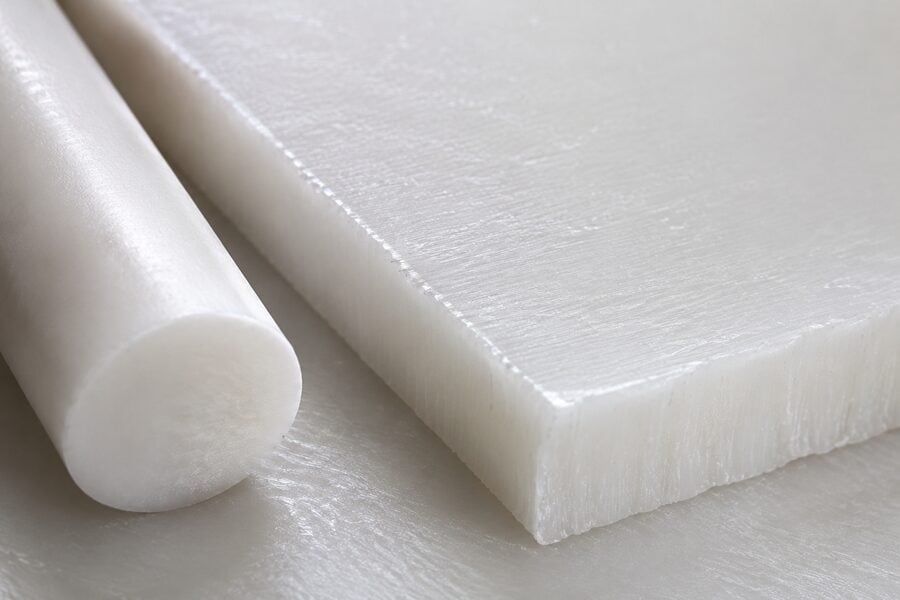
20-uhmw-pe-texture

 What We Run

Material Character Typical use
UHMW-PE Extremely abrasion resistant, low friction, self-lubricating. Melting point around 270°F. Wear strips, guide rails, conveyor components, chute liners, food-contact parts.
HDPE Stiffer, lower molecular weight than UHMW. Slightly easier to machine, same underlying limits. Chemical tank components, fabricated assemblies, wear applications, food-contact parts.


FDA-compliant grades are available in both materials for direct food-contact applications. Specify the requirement at RFQ so we source correctly — it is a material decision, not a process one. 

 Tolerances We Hold, Honestly

Part type Realistic tolerance Why
General machined parts ±0.005" Thermal expansion roughly 18× steel, plus elastic springback
Large or thin parts ±0.010" Both effects scale with size and reduce with stiffness
Die-cut and precision-cut sheet Per fabrication tolerance Often the more economical route on thin sheet


NOTE*:  
Do not accept ±0.001" on UHMW from any supplier. The physics do not support it. If your part genuinely needs that tolerance, the material is wrong  acetal at ±0.001" or PEEK at ±0.0002" are the right conversations, and we will have them with you.

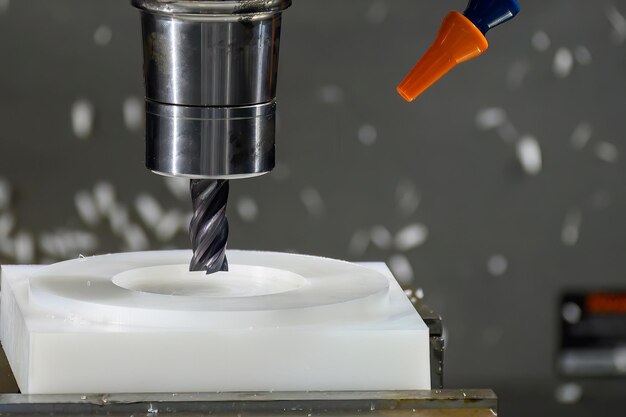
cnc-milling-machine-cutting-nylon-6-material-part-with-flat-end-mill-tool-nylon-alloy-wheel-parts-cutting-process-by-machining-center-with-square-end-mill_1156970-22

How We Machine and Fabricate It 

Milling on our vertical machining centers with vacuum-table or double-sided-tape fixturing mechanical clamping distorts the part and puts the dimension out before the cutter touches it. Razor-sharp tooling throughout: dull metal-cutting tools ruin both the tolerance and the finish on polyethylene. Climb milling, peck drilling with 12 to 18 degree twist angles to allow cooling, and saw blades with zero tooth rake. 

Cutting speeds run 600 to 1,000 feet per minute at 10 to 40 feet per minute feed. We prefer vacuum and air-blast cooling over liquid coolant where tolerance matters, because the goal is to carry heat away without introducing another variable. 

For sheet parts, precision cutting and die cutting on the fabrication side is frequently the cheaper and better answer than milling particularly on thin wear strips and liners at quantity. We will tell you which route is more economical for your part rather than routing everything through a mill. 

What Makes UHMW and HDPE Different

Polyethylene is easy to cut and hard to cut accurately, and the difference is knowing what the material does under the tool. 

Heat is the whole problem

Thermal conductivity is very low, so cutting heat goes into the tool and the workpiece rather than leaving in the chip. High pressure flood coolant is effectively mandatory, and even with it, tool life is a fraction of what the same geometry gives in steel. 

Springback is real and it is measurable

UHMW deflects under both tool pressure and clamping load, then returns to shape once released. This is why vacuum fixturing matters and why a bore machined to size can measure undersize afterwards. It is also why quoting metal tolerances on this material is meaningless regardless of the machine. 

It will not bond or paint without treatment

Polyethylene is essentially unbondable and unpaintable as supplied. Adhesive bonding requires flame or corona surface treatment first, and fabricated assemblies are joined by hot-plate or extrusion welding rather than adhesive. Plan the joining method into the design. 

Finishing and Post-Processing

In-house at Steelcrest

  • Precision cutting and die cutting of sheet parts
  • Fabrication, weldment and assembly of built-up units
  • Saw cutting, deburring, CMM inspection

Managed through qualified partners

  • Flame or corona surface treatment where bonding or printing is required
  • Hot-plate and extrusion welding for tanks and large fabricated assemblies

Industries We Machine UHMW and HDPE For

Steelcrest Precision machines UHMW and HDPE into wear strips, guide rails, rollers, and chute liners for food and beverage processing, material handling and warehousing systems, and agriculture and construction equipment.

Talk To Us About Your UHMW-PE & HDPE Parts. 

Send the drawing and the quantity. We will come back with a real number, a real lead time, and if there is a better material or condition for what the part has to do we will tell you that too. 

Frequently Asked Questions

Can you hold ±0.001" on UHMW?

No, and neither can anyone else. UHMW's thermal expansion is around eighteen times that of steel, so a single degree Fahrenheit moves a ten-inch part 0.0011". Add elastic springback under tool and clamping pressure and ±0.005" is the realistic band, or ±0.010" on large or thin parts. If your part needs ±0.001", the material is wrong and we will suggest an alternative. 

Do you stock FDA-compliant grades?

We source FDA compliant UHMW and HDPE for direct food-contact applications. Specify the requirement at RFQ — it is a material sourcing decision and it needs to be made before the job starts. 

Should my part be machined or die-cut?

On thin sheet parts at quantity wear strips, liners, gaskets and slip sheets die cutting is frequently faster and cheaper than milling. Send the drawing and the annual quantity and we will tell you which route costs less. 

Why does my UHMW bore measure undersize?

Springback. UHMW deflects under tool and clamping pressure and returns to shape when released, so a bore cut to 0.500" can measure 0.495" out of the fixture. Vacuum or tape fixturing rather than mechanical clamping is the main countermeasure. 

Can UHMW parts be glued or painted?

Not without surface treatment. Polyethylene is essentially unbondable and unpaintable as supplied flame or corona treatment is required first, and fabricated assemblies are usually hot-plate or extrusion welded instead.