
Steelcrest Precision

Every buyer has a story about the shop that missed the date. The quote looked great in March, the parts were due in May, and by July your customer was on the phone with you. The part was 12% cheaper. The line-down charge was not.
Choosing a CNC machining partner is a supply chain decision that shows up on every drawing you release. This guide covers the seven things experienced buyers evaluate — capabilities, equipment, quality systems, inspection, capacity, communication, and industry experience — and the red flags that predict trouble before the first PO. It builds on our Complete Guide to Precision Machining, which covers the processes and tolerances themselves.
THE SHORT ANSWER
To choose the right CNC machining partner, verify five things: (1) the shop's equipment and daily work match your part's processes, materials, and tolerances; (2) its quality system carries the certification your industry requires; (3) it can measure what it makes, with CMM inspection and documented first-article processes; (4) it has the capacity and on-time delivery record to hit your date; and (5) it quotes fast and communicates like a partner. Price comes last — a cheap part that shows up late isn't cheap.
The machining market is fragmented — tens of thousands of shops, most small and local — so quotes for the same drawing vary widely. That makes price the easiest column to sort by and the least useful one. The real cost of a supplier is the quote plus everything it doesn't capture: expedite fees when the date slips, rework when quality drifts, and the downstream cost when your line or your customer waits on a late part.
So the evaluation runs in this order. Capability and quality determine whether a shop can make your part. Capacity and communication determine whether it will — on the date it promised.
The best predictor of success is whether the shop already runs work like yours — same processes, same material class, same tolerance band. A shop that excels at high-volume turned aluminum can still be the wrong choice for low-volume, tight-tolerance ground steel.
Match the shop's core processes to your drawing:
Setups matter as much as machine type: every refixture stacks tolerance and adds cost. A shop with 5-axis and mill-turn machines finishes complex geometry in one or two setups where a 3-axis shop needs five — and that shows up in both your price and your dimensional consistency.
Most shop websites show you their newest machine. What you want to know is what's behind it. Two questions cut through the photography:
“How many machines can run my part?” If the answer is one, your lead time depends on one spindle's health and one backlog. Redundancy — several machines of the same class, staffed across shifts — is what turns a promised date into a reliable one.
“Do you track tolerance capability by machine?” A professionalized shop knows what each spindle reliably holds and routes work accordingly. A shrug means tolerance assignment happens by habit, not data.
| 100+ | ±.001" | 4-6 Weeks |
| CNC MACHINES, ONE ROOF | STANDARD PRECISION TOLERANCE | THE DOMESTIC LEAD-TIME WINDOW |
For regulated work, certification is the condition of entry. Match it to your industry:
One distinction worth insisting on: “pursuing” a certification is not the same as holding it. A shop that tells you plainly where it stands — certified, in audit, or building toward it — is showing you how it will communicate about everything else. (For our part: Steelcrest Precision is actively pursuing AS9100 as part of a structured aerospace buildout, and we'll tell you exactly where that stands when you ask.)
Beyond the certificate, ask to see the quality manual and recent nonconformance trends. A confident shop shares them.
Tolerances on a drawing are claims. Inspection is proof. Confirm the shop can verify the dimensions it promises to hold:
Every shop promises on-time delivery. Few volunteer their number. Ask these four questions and listen for specifics:
This is where scale quietly matters. A shop running a hundred-plus machines across dedicated departments — milling, turning, grinding, EDM, sawing — can absorb a down spindle or a rush order without your delivery paying for it. An owner-operator with six machines and a retirement date cannot, however skilled he is. With experienced machinists and shop owners aging out of the trade, supplier continuity is now a real evaluation criterion.
THE MISSED-DATE MATH
Say a competing quote saves you 10% on a machined component. If the late delivery it comes with idles an assembly line, triggers expedited freight, or delays a program milestone, that 10% evaporates in the first day — and the costs keep running after the savings are gone. Delivery reliability isn't a soft factor. It's risk reduction you can price.
You learn more about a machine shop from its quoting behavior than from its brochure:
A shop that already serves your industry has already made the mistakes you'd otherwise pay for. Aerospace and defense bring FAI documentation, configuration control, and export-controlled data handling; medical brings biocompatible materials and validation protocols; industrial equipment brings volume ramps and cost-down expectations. Ask what industries the shop ships into today, and ask for the part types — not customer names, which a professional shop won't share anyway — that look like yours.
| Ask about… | Green flag | Red flag |
|---|---|---|
| Equipment | Multiple machines can run your part; tolerance capability tracked per machine | One machine, one operator, one point of failure |
| Quality system | Certificate status stated plainly; quality manual shared on request | Vague language that implies a certification the shop doesn't hold |
| Inspection | CMM with calibration records; documented FAI; in-process checks | “We check everything at the end” |
| Delivery | OTD tracked and quoted as a number; realistic lead times | Every date is “no problem” until it's a problem |
| Quoting | Fast turnaround with DFM questions and feedback | Weeks of silence, then a number with no questions asked |
| Price | Competitive quote with the delivery record to back it | A price so low the shop can only keep it by cutting corners — or missing dates |
One more factor buyers weigh in 2026: geography. Offshore suppliers can win on unit price — but only when your program can absorb long lead times, freight variability, tariff exposure, and quality problems discovered an ocean away from the machine that caused them. For many buyers the dividing line falls in the four-to-six-week range: inside that window, a responsive domestic shop is usually the lower-risk, lower-total-cost choice. Reshoring isn't a slogan; it's buyers doing this math.
If that math points you toward a regional supplier, the next question is which capabilities are actually available near you. Sourcing Machined Parts in Northwest Ohio covers the regional supply base in depth — what's available inside an hour's drive, when proximity genuinely changes your cost and schedule, and which aerospace work actually requires an AS9100-certified supplier.
If the order matters, visit. An hour on a shop floor tells you what no website can: whether the place is organized, whether machines are maintained, and whether quality and delivery metrics are posted where the people running the parts can see them. A shop that's proud of its floor will invite you. Take them up on it.
WHY STEELCREST PRECISION
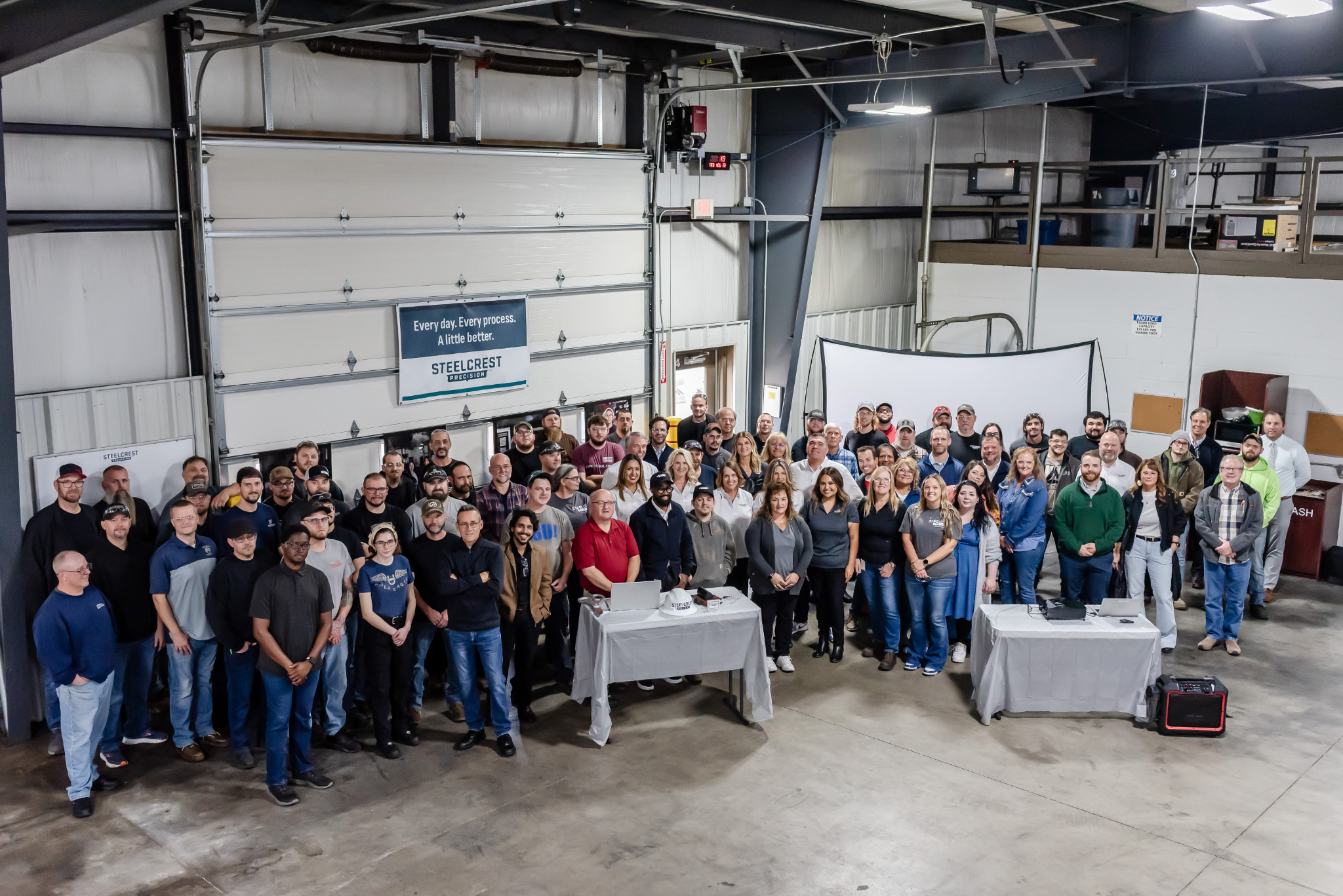
Steelcrest Precision runs 100+ CNC machines across dedicated milling, turning, grinding/EDM, and fabrication departments in Wauseon, Ohio — enough capacity to take on serious work and still hit the date, with tolerance capability tracked machine by machine and precision work held to ±.001". We're actively pursuing AS9100 as part of a structured aerospace buildout, and we'll give you a straight answer on capability, lead time, and DFM before you're committed. See our full capabilities.
What should I look for when choosing a CNC machine shop?
Evaluate seven things: process and material capabilities that match your part, equipment depth and redundancy, quality certifications appropriate to your industry, inspection capability (CMM, FAI, in-process control), capacity and on-time delivery track record, quote responsiveness and communication, and experience in your industry. Weigh total cost of ownership — including the cost of late or nonconforming parts — over unit price alone.
What certifications should a CNC machine shop have?
It depends on your industry. ISO 9001 is the baseline for commercial and industrial work. Aerospace requires AS9100 (held or actively in progress, per your flow-down requirements). Medical device work calls for ISO 13485. Defense-controlled work requires ITAR registration. Always verify current certificate status directly rather than relying on website claims.
How do I evaluate a machine shop's quality control?
Ask about CMM inspection capability and calibration records, first-article inspection (FAI) documentation, in-process checks or SPC during production runs, and material traceability. A shop that controls quality during the run is a better risk than one that only inspects finished parts.
Why does machine shop capacity matter?
Capacity determines whether a promised date is reliable. A shop with multiple machines capable of running your part can absorb equipment downtime, rush orders, and demand spikes without delaying your delivery. A shop where your part has exactly one path through the building is a single point of failure.
Is it better to choose a large machine shop or a small one?
Match the shop to the work. Small shops can be excellent for simple, low-volume parts. For production programs, regulated industries, or parts where a missed delivery is expensive, a larger professionalized shop offers equipment redundancy, documented quality systems, and continuity that owner-operator shops — many facing retirement without a succession plan — often can't guarantee.
Should I choose a domestic or overseas machine shop?
For lead times inside roughly four to six weeks, domestic shops typically win on total cost once freight, tariff exposure, communication delays, and quality-recovery risk are counted. Overseas sourcing can make sense for high-volume, long-horizon programs that can absorb extended lead times and supply chain variability.